Chapter 19:

THE reputation economy
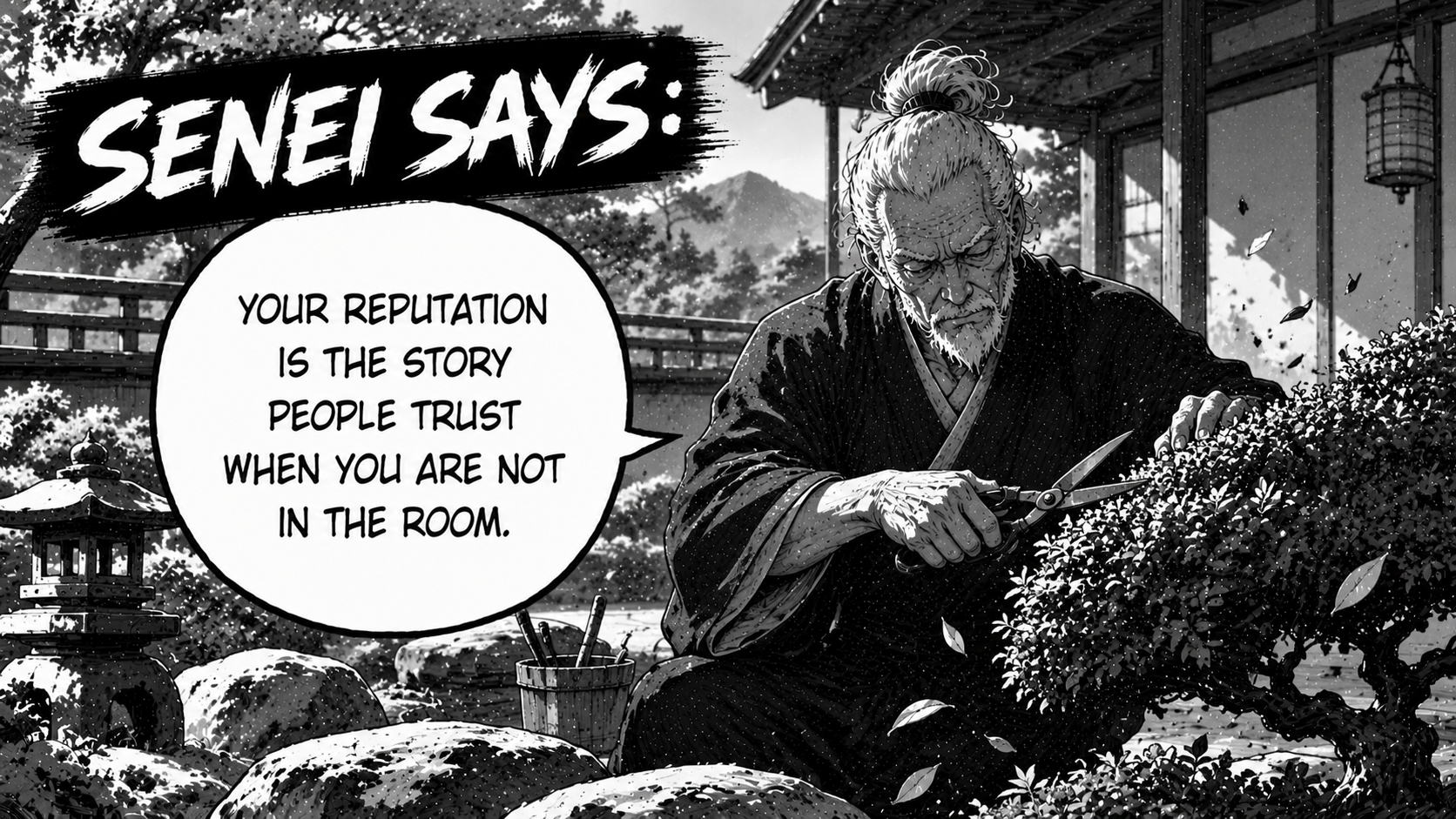
People talk about you when you leave the room.
Not always in a dramatic way. Not always in a cruel way. Sometimes it is one sentence after a meeting, a comment after a client call, a small exchange in the car park, or a message that starts with, “How was working with them?”
That sentence matters.
Because your reputation is being built whether you are managing it or not.
Every interaction leaves evidence. Every deadline. Every promise. Every moment under pressure. Every email. Every recovery after a mistake. Every time you take responsibility. Every time you avoid it. Every time people feel safer because you were involved. Every time they feel they need to protect themselves from your chaos.
This is the reputation economy.
It is not about personal branding. Personal branding is what you say about yourself. Reputation is what other people believe after experiencing you. That is a much harder currency to manipulate. You can design a clean profile. You can write a clever bio. You can post impressive updates. You can use words like “visionary,” “strategic,” “human-centred,” and “transformational” until the algorithm offers you a leadership podcast.
But people who have worked with you know the real story.
They know whether you follow through. They know whether your confidence has substance. They know whether your urgency becomes everyone else’s panic. They know whether you treat people well when you do not need anything from them. They know whether your standards sharpen the work or shrink the room. They know whether your apology means change or just damage control.
Reputation is built one interaction at a time. That is what makes it unfair and beautiful.
Unfair, because one bad moment can travel further than ten good ones. Beautiful, because trust can compound when your behaviour becomes consistent enough for people to rely on.
The mistake many people make is believing reputation is built through intensity. One big win. One impressive pitch. One heroic rescue. One late-night sacrifice. One moment where everyone says, “Wow, they really came through.”
Those moments help. But consistency beats intensity.
The person who is brilliant once and unreliable ten times becomes a gamble. The person who is solid, honest, prepared, and useful again and again becomes trusted. Trust is not built through fireworks. It is built through repeated evidence.
Early in your career, you build a reputation. In management, you protect it. At executive level, you leave a legacy that becomes larger than your own performance.
That is the progression.
When you start out, people are asking, “Can I trust this person with the work?”
When you manage others, they are asking, “Can I trust this person with people?”
When you become senior, they are asking, “Can I trust this person with the future?”
The higher you climb, the more your reputation stops being about your personal output and starts becoming about the world you create around you.
It becomes the story that enters the room before you do.
Main Character Analysis: Thor
Thor follows the arrogant but powerful Norse god Thor, who is banished from Asgard to Earth after his reckless actions threaten peace between realms. Stripped of his powers, Thor is forced to learn humility, responsibility, and what it truly means to be worthy. While on Earth, he forms a bond with scientist Jane Foster, while his brother Loki schemes to take control of Asgard.
It is ultimately about becoming worthy through character, not power.
Thor begins in the Marvel Cinematic Universe as a powerhouse with a reputation problem. He is strong, royal, admired, feared, and capable of dramatic entrances that would make most corporate leaders deeply jealous.
But at the start, his reputation is not built on wisdom.
It is built on power.
He is arrogant, hot-headed, impulsive, and convinced that strength gives him the right to act without consequence. He wants glory before humility. Victory before responsibility. Recognition before maturity.
Then he is stripped of power.
Thor’s transformation begins when the external symbol of his worth is removed. No hammer. No throne. No easy proof that he is who he says he is. He has to become worthy without the thing that made him look worthy.
That is where his reputation begins to change.
Thor learns humility. He learns sacrifice. He learns that leadership is not domination. He endures loss, failure, grief, and responsibility. Over time, he evolves from a generic powerhouse into a more human figure: still mighty, but also wounded, loyal, funny, broken, resilient, and capable of protecting others without needing every scene to prove he is the strongest.
His reputation changes because his behaviour changes.
People stop experiencing him only as force. They begin experiencing him as someone who can carry loss and still show up. Someone who can be powerful without being ruled by pride. Someone who becomes more relatable because he stops being untouchable.
This is a leadership lesson. At the beginning of a career, people may notice your talent. Later, they watch your character. Talent can open the door. Character decides what people say after working with you.
Thor had power before he had maturity. Many professionals do too. They are sharp before they are safe. Fast before they are thoughtful. Ambitious before they are generous. Confident before they are grounded.
But if they grow, their reputation evolves.
The best reputations are not perfect. They are earned through visible change, consistent behaviour, and the ability to become better after being wrong.
Power can make you known. Worthiness makes you trusted.
NPC Behaviour to Avoid
Do not treat reputation like something you only manage when people are watching.
Avoid being impressive in the room and careless outside it.
Avoid making promises casually, then treating follow-through as optional.
Avoid blaming every fallout on other people.
Avoid telling a version of the story where you are always the victim, the misunderstood genius, or the one who was “screwed.”
Avoid treating suppliers, freelancers, juniors, or crew as disposable because they do not control your next opportunity.
Avoid thinking one good performance cancels repeated bad behaviour.
Avoid leaving people with the sentence, “They are talented, but…”
That “but” is expensive. It usually means the talent is real, but the risk is louder.
Tales from My Adventure
In the events industry, stories travel.
Sometimes faster than invoices. You hear about people. Not always officially. Not always in meetings. Sometimes it happens in passing, through suppliers, freelancers, crew, clients, technical teams, production teams, and people who have been around long enough to know who leaves damage behind.
You hear about business partners who had ugly fallouts. You hear about people who do not pay suppliers or freelancers properly. You hear about people who damage equipment and then act as if responsibility is a rumour. You hear about people who are lazy, unreliable, careless, or brilliant only when someone senior is watching. You hear about people who get fired for poor behaviour, then tell the market a story about how they were betrayed.
I am not talking about one specific person.
That is the point.
The pattern is common.
Every industry has people whose reputation arrives before they do, and not in the way they think. The difficult part is that negative stories seem to last longer than positive ones. People may not always tell ten stories about how kind, reliable, ethical, generous, or disciplined someone is. But if someone does not pay, breaks trust, damages relationships, or leaves a trail of chaos, that story finds legs.
Wrong things can become a longer legacy than right things.
That may feel unfair, but it makes sense.
Risk travels.
People warn each other about risk because risk costs money, time, trust, energy, and sometimes safety. If someone has been burned before, they tell others where the fire was. It affects who wants to work with you, who trusts you with clients, who gives you access, who recommends you, who protects you, who avoids you, and who says your name when opportunities appear.
Early in your career, you may think the work is enough.
Do the task. Get paid. Move on.
But the work is only part of the story. How you do the work becomes the reputation. Do you solve problems or create them? Do you take responsibility or build excuses?Do you protect relationships or burn them when pressure rises? Do people feel safer when you are involved, or do they start preparing screenshots?
As your career grows, your reputation becomes less about whether you can do the work and more about whether people can trust the ecosystem around you.
A bad reputation does not always destroy you immediately. Sometimes people with bad reputations still get work because they are talented, connected, entertaining, powerful, or useful in the short term.
But reputational debt collects interest.
The goal is not to become perfect. Nobody has a flawless reputation. Everyone makes mistakes. Everyone has moments they would prefer the market not turn into folklore. The goal is to build enough trust that people believe your mistakes are not your pattern.
Character Build Exercise: Audit Your Reputation
Write down the reputation you want in one sentence.
“I want people to experience me as someone who __________.”
Now answer honestly:
What do people currently trust me with?
What do people hesitate to trust me with?
What sentence might people say about me after I leave the room?
What “but” might follow my name?
Example: “They are talented, but __________.”
What behaviour is creating that “but”?
What is one promise I need to keep more consistently?
What relationship, supplier, client, colleague, or team member needs repair?
What pattern do I need to stop before it becomes my reputation?
Now complete this:
“My reputation will improve when I consistently __________, especially when __________.”
Reputation is not rebuilt through announcements.
It is rebuilt through repeated evidence.
SUBSCRIBE TO THE EMAIL LIST AND NEVER MISS AN UPDATE
New Chapters Are Dropping Every Month